
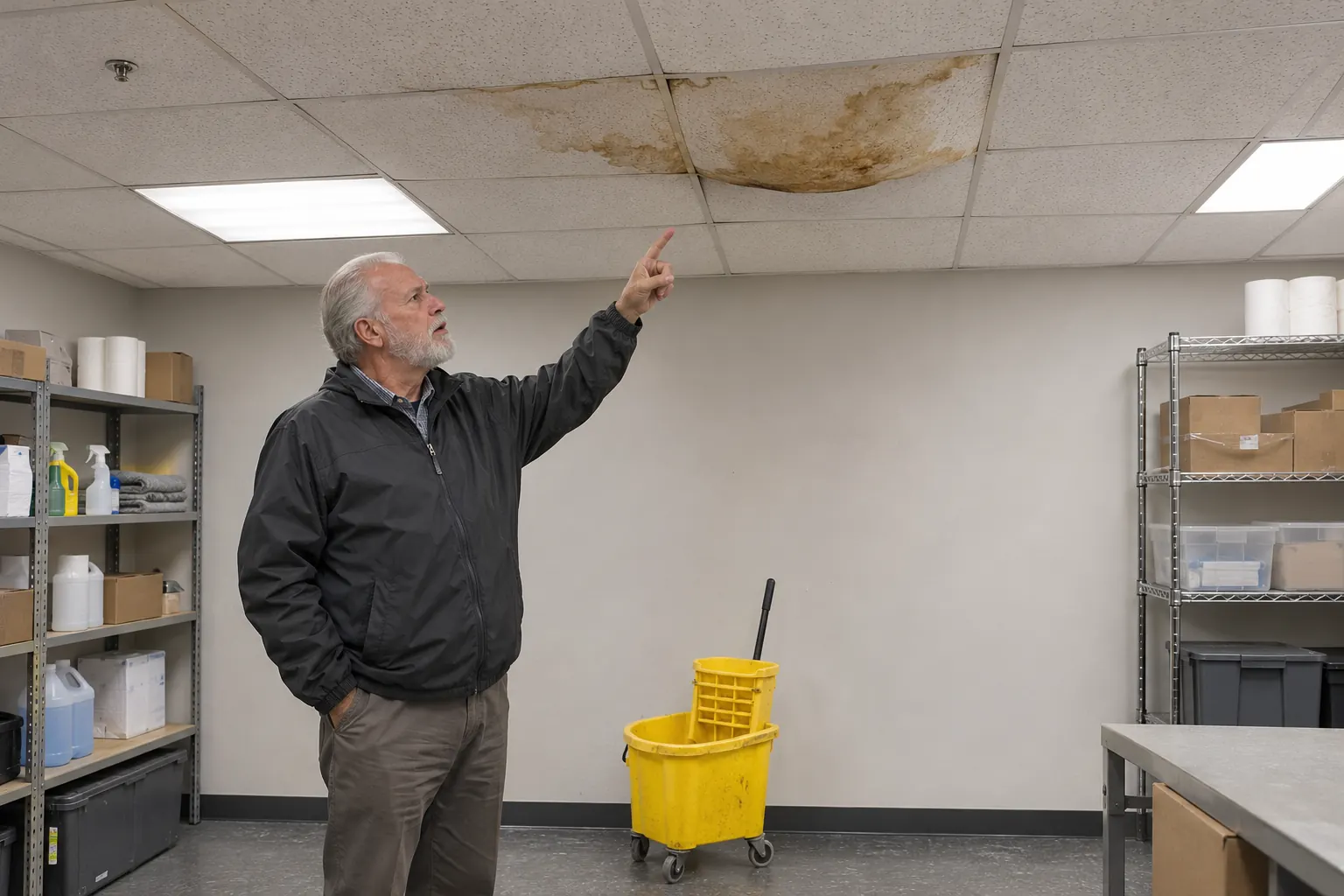
Roof leak dripping through the ceiling inside a commercial building
FAQ · Richmond, KY

Commercial Roof Repair Questions in Richmond

Get Straight Answers About Seams, Screws, Leaks, and Permits

These commercial roof repair questions in Richmond come from building owners and facility managers, with answers on flat roofs, metal roofs, leaks, and plant roofs.

  • Membrane Roofs
  • Metal Panel Roofs
  • Built-Up And Mod Bit
  • Plant And Shop Roofs

Richmond Commercial Roof Repair Questions, Grouped by Topic

Every one of these commercial roof repair questions in Richmond is answered below, grouped by roof type and topic so you can jump to yours.

Commercial roof repair is the trade of tracking down leaks and fixing split seams, damaged flashing and worn metal on business, industrial and farm roofs. Richmond Commercial Roof Repair fixes flat and metal commercial roofs on buildings in Richmond and the rest of Madison County, Kentucky, and in surrounding towns like Berea, McKee, Irvine, Stanton and Mount Vernon.

Commercial Roof Repair Questions in Richmond by Roof Type

Basics first, then flat, metal, leak, and industrial roof repair.

Commercial Roof Repair Basics

Which problems does commercial roof repair fix?

Commercial roof repair fixes a specific failure on a commercial roof while the rest of the roof system stays in service. The goal is to stop water at its entry point and restore the damaged section to match the roof around it.

Typical repair jobs on low-slope and metal roofs:

  • Split or open seams on TPO, EPDM and modified bitumen.
  • Torn base flashing at parapets, curbs and walls.
  • Backed-out screws and cracked washers on metal panels.
  • Punctures from foot traffic, hail or dropped tools.
  • Clogged or broken drains, scuppers and gutters.
  • Loose edge metal and coping after wind.
Should a commercial roof be repaired, restored or replaced?

A few isolated failures call for repair, a worn surface over dry insulation calls for restoration, and widespread wet insulation or rusted-through metal calls for replacement.

PathRoof conditionWork involved
RepairIsolated leaks, a few bad seams or flashingsPatch, reweld or reseal the failed spots
RestoreAging surface, mostly dry insulation, solid deckRepairs first, then a coating over the whole roof
ReplaceLarge wet areas, failed deck, rust-through across many panelsTear-off or recover with a new system

Moisture readings and core cuts separate restoration candidates from replacement, since wet insulation underneath a dry-looking membrane rules out a coating.

How does a temporary roof patch compare with a permanent repair?

Temporary repairs buy time by keeping water out of the building, and permanent repairs rebuild the failed spot with materials matched to the roof system.

FactorTemporary repairPermanent repair
When it happensDuring or right after rain, or in cold weatherOnce the roof is dry and within material temperature limits
MaterialsRoof cement, tape, wet-surface sealantMatching membrane, welded or primed patches, new flashing, new fasteners
Surface prepMinimalCleaned, primed and dried
Expected roleHolds until the real repairBecomes part of the roof

Every temporary patch on a membrane roof gets cut out or cleaned off when the permanent repair goes in, because roof cement interferes with welds and seam tape.

Why do commercial roofs fail at edges and penetrations first?

Edges and penetrations fail first because they are where the membrane or panels change direction, meet another material or move against something fixed. A pipe boot, a curb corner or a parapet base sees daily expansion and contraction that the open field of the roof avoids.

Wind also pulls hardest at the perimeter, lifting edge metal and coping. Sealant at counterflashing and pitch pans dries out in sun faster than the membrane wears. For that reason, a repair visit starts at the perimeter, curbs, drains and every pipe through the roof before moving to the open field.

Flat Roof Repair Questions

How are split seams fixed on TPO, EPDM and other flat roof membranes?

Each membrane has its own seam repair, because TPO and PVC weld with heat while EPDM and modified bitumen rely on adhesives, tape or heat-fused asphalt.

MembraneSeam repair methodKey prep step
TPOClean and reweld, or weld a cover strip over the seamRemove dirt and oxidized surface so the weld takes
PVCReweld or weld a cover stripClean with a membrane cleaner
EPDMPrime and apply seam tape or a cured cover stripScrub off talc and dirt with primer
Modified bitumenHeat or adhere a cap sheet patch over the lapDry the lap and remove loose granules
Built-upCut out the failed area and rebuild pliesDry the area and remove gravel

Seam repairs extend a few inches past the failed section on both ends.

What can be done about ponding water on a flat roof?

Ponding water is fixed by finding why it sits there, which is usually a clogged drain, a drain set too high, sagging deck or crushed insulation. Clearing debris from drain strainers and scuppers solves the simplest cases.

For low areas that stay wet after the drains are clear, repair options include:

  • Adding tapered crickets in the low area and patching new membrane over them.
  • Resetting a drain bowl lower so water reaches it.
  • Cutting out crushed insulation and replacing it with firm board.
  • Installing a scupper through the parapet where water collects at the edge.

Long-term ponding speeds wear on seams and patches, so these repairs protect the rest of the roof too.

How are blisters on a flat roof repaired?

Blisters on built-up and modified bitumen roofs are repaired by cutting them open, drying the area, and patching with matching plies once the layers lie flat. They form when trapped moisture or air expands under the surface in summer heat.

Small, firm blisters away from seams and drains often get monitored at each visit. A blister needs repair once it cracks, sits at a lap or keeps growing. Single-ply TPO and EPDM roofs show a different problem, loose areas where adhesive has let go, and those spots get cut, re-adhered and covered with a patch.

Can punctures and foot-traffic damage on a flat roof be patched?

Punctures from foot traffic, hail or dropped tools are patched with the same membrane as the roof, set over a cleaned area that extends past the damage. Punctures near RTUs and roof hatches are the most common, since that is where service crews walk and set tools down.

The repair follows a short order:

  • Probe the hole and check the insulation underneath for wetness.
  • Replace any wet board before closing the roof.
  • Clean and prime or prepare the membrane around the hole.
  • Weld or adhere a rounded-corner patch.

Walkway pads along service routes cut down on repeat punctures.

How are pitch pans, pipe boots and curbs repaired on a flat roof?

Pitch pans are refilled or replaced, pipe boots are swapped for new ones sized to the pipe, and curb flashing is rebuilt where it has split or pulled away. These details leak more than open membrane because sealant and flashing age faster than the field sheet.

Repair choices by detail:

  • Pitch pans: old filler shrinks and cracks, so crews refill it with pourable sealer or replace the pan with a premolded boot.
  • Pipe boots: cracked rubber and loose clamps get a new boot welded or taped to the membrane.
  • Curbs: split corners and open laps at RTU curbs get new flashing run up the curb and under the counterflashing.

Commercial Metal Roof Repair Questions

Why do screws on a metal roof start leaking?

Screws on exposed-fastener metal roofs leak when the rubber washer dries and cracks or when panel movement backs the screw out of its hole. Every day the panels heat and expand, then cool and shrink, and that motion works against each fastener.

Repairs for fastener leaks:

  • Tighten screws that still bite firmly and have good washers.
  • Replace screws with cracked washers using new screws and washers.
  • Upsize to a larger-diameter screw where the hole has stripped.
  • Seal the heads with fastener caps or sealant on roofs with heavy back-out.

A full fastener pass covers every screw on the roof, since one leaking row tends to mean others are close behind.

How are leaky end laps and side laps on Richmond metal roofs repaired?

Leaking laps are repaired by opening or cleaning the joint, replacing failed sealant and fasteners, and sealing the lap with tape or reinforced sealant. End laps leak more often than side laps because water runs straight into the joint where one panel overlaps the next downslope.

On low-slope R-panel roofs, water also gets pulled into laps by capillary action. Crews check for rust staining at the lap, missing stitch screws and gaps where the panel ends have spread apart.

Rusted lap edges get wire-brushed and primed before new sealant or butyl tape goes in, and missing stitch screws get replaced so the panels clamp together again.

Can rusted metal panels be patched?

Rusted metal panels can be patched when the rust is limited to small spots and the surrounding steel is still firm, but panels rusted through in larger areas need replacing. Crews test the steel by pressing on it with a screwdriver.

Rust conditionRepair
Surface rust, steel firmWire brush, prime and seal
Pinholes in a small areaPrimer plus reinforced patch or a sheet-metal patch
Rust-through across a panelReplace the panel
Rust along the eave and gutter lineReplace the bottom panels or eave trim

Rust at the eave is common because water and debris sit there longest. Panel replacement on exposed-fastener roofs means matching the rib profile so laps seal.

How are metal roof gutters, valleys and ridge caps repaired?

Gutters, valleys and ridge caps are repaired by resealing seams, replacing rusted sections and refastening loose pieces. Each one handles a lot of water or wind, so small failures turn into interior leaks quickly.

Common fixes:

  • Gutters: reseal end caps and joints, replace rusted sections and reset hangers so the gutter slopes to its downspout.
  • Valleys: clear debris, replace rusted valley metal and reseal where panels meet it.
  • Ridge caps: replace missing closures, refasten the cap and seal laps between cap sections.

Downspouts get checked at the same time, because a blocked downspout overflows the gutter back toward the wall.

How do membrane roof repairs differ from metal roof repairs?

Membrane roof repairs center on seams, patches and flashing adhered to the sheet, while metal roof repairs center on fasteners, laps, trim and replacing damaged steel.

Repair areaMembrane roofsMetal roofs
Main leak pointsSeams, flashing, penetrations, drainsFasteners, end laps, ridge caps, gutters
Patch materialMatching TPO, EPDM, PVC or bitumenSealant with fabric, butyl tape or new steel
Wet insulation checkMoisture scan and core cutsInspection from inside for wet batts and rust
Movement concernShrinkage pulling at curbs and wallsThermal movement backing out screws
ToolsHot-air welder, primer, rollerScrew gun, brushes, sealant, snips

Mixed buildings often have both, with a metal high roof draining onto a membrane low roof, so the joint between them gets its own flashing check.

Commercial Roof Leak Repair Questions

How do roofers trace a leak on a commercial roof?

Roofers trace a leak by starting at the interior stain, measuring its location, and then working uphill on the roof from that point, because water often travels before it drips. On a steel deck, water can run along the flutes for some distance from where it entered.

The tracing order:

  • Mark the ceiling stain or drip on a building plan.
  • Find the matching spot on the roof and check every seam, curb and pipe uphill of it.
  • Look for open laps, split flashing and loose fasteners in that path.
  • Water-test suspect spots one at a time, starting downhill.

Water testing pinpoints the entry when visual checks come up empty.

Where do leaks start on each type of commercial roof?

Leaks start in predictable places on each roof type, and checking those spots first speeds up the repair.

Roof typeUsual leak sources
TPO or PVCCold welds, T-joints, pipe boots, curb corners
EPDMSeam tape edges, shrinkage at walls, pipe boots, termination bar
Modified bitumen or built-upBlisters, open laps, pitch pans, base flashing
Standing seam metalSeam ends, ridge closures, curbs, trim screws
R-panel metalScrews and washers, end laps, skylight panels, gutters

Skylights, RTU curbs and parapet walls show up on every list because they break up the roof surface.

Can wet insulation be found before cutting into the roof?

Wet insulation can be found from the roof surface with a moisture survey, using infrared, capacitance or similar meters to map areas holding water. Infrared scans work at night after a sunny day, when wet insulation releases heat more slowly than dry.

The survey marks suspect areas on a roof plan. Crews then cut small test cores in those areas to confirm what the meter shows, and patch each core right away.

Finding wet insulation matters for repair planning. Patching a seam over soaked boards leaves water trapped under the membrane, so those boards come out before the new patch goes in.

What should building staff do when water comes through the ceiling?

Building staff should protect people and contents first by moving equipment, setting out buckets and roping off wet floors, and then record where and when the leak appears. Stay off the roof during storms and lightning.

Useful details to record:

  • Location of each drip, matched to a column line or room number.
  • Time the leak started relative to the rain.
  • Wind direction during the storm.
  • Photos of ceiling tiles, deck stains and any water running along beams.

Those notes help a crew tie the drip to a specific seam, curb or drain on the roof.

Why does the same commercial roof keep leaking after repairs?

Repeat leaks usually mean the first repair treated the wrong spot or used materials that do not bond to the roof. Water that enters at a curb uphill can show up far from the patch, and roof cement smeared over a TPO seam fails because it cannot bond to the membrane.

Other causes of repeat leaks:

  • Wet insulation left under the patch.
  • Drains or gutters still clogged, holding water against the repair.
  • Movement at expansion joints or long metal panel runs.
  • Several leaks at once, with only one found.

A full roof check, rather than another patch on the same spot, breaks the cycle.

Industrial Roof Repair Questions

How are roofs around exhaust fans and process vents repaired?

Roofs around exhaust fans and process vents are repaired by cleaning off grease or residue, removing membrane the residue has softened, and patching with a material that resists it. Kitchen grease and some process oils swell EPDM and break down other membranes over time.

Repair steps around exhaust:

  • Degrease and cut out damaged membrane down to firm sheet.
  • Patch with a compatible membrane, often PVC near grease.
  • Add a sacrificial pad or grease containment box under the fan.
  • Check the fan curb flashing and hinge kit.

Fan filters and grease containment kept in good order mean less residue reaches the membrane.

Can roof repairs happen on a plant roof while production runs?

Roof repairs happen on plant roofs while production runs in nearly every case, since crews work from the outside and open only small areas at a time. Coordination with plant safety staff covers the details that affect operations.

Points to settle with the plant:

  • Hot work permits for torch-applied modified bitumen or welding near vents.
  • Air intake shutoffs when adhesives or primers are used.
  • Lockout of rooftop equipment the crew has to work on.
  • Roof access routes, sign-in and fall protection rules.

Repairs over clean rooms, food lines and electrical rooms get extra interior protection.

How are expansion joints and large curbs repaired on industrial roofs?

Expansion joints are repaired by replacing the failed bellows or cover and reflashing both sides, while large curbs get new flashing run up the curb and sealed under the equipment's counterflashing. Both details move more than the roof around them, so rigid patches crack.

Expansion joints on long industrial buildings separate sections that move independently. A split bellows or a joint cover lifted by wind lets water straight into the building. Large curbs under make-up air units and dust collectors leak at corners and along the upper edge where flashing meets the unit.

Repairs use flexible flashing that can stretch as the building moves.

What repairs do rooftop equipment changes leave behind?

Equipment changes often leave abandoned curbs, unused pipe supports and open holes where old units sat, and each one needs proper closure. A curb left with a plywood cover or an old pitch pan with no pipe in it is a common leak source on industrial roofs.

Closure options:

  • Remove the abandoned curb, infill the deck opening and patch the roof over it.
  • Cap a curb that will be reused later with a sealed metal cover.
  • Pull unused pipe supports and patch the membrane under them.
  • Seal or remove empty pitch pans.

Crews also check new equipment curbs for missing crickets on the uphill side.

How can foot traffic damage on an industrial roof be reduced?

Walkway pads along service routes, clear access rules and quick repair of small punctures reduce foot traffic damage on industrial roofs. Service crews walk to RTUs, exhaust fans and roof hatches often, and dropped screws, panels and tools puncture membrane.

Practical steps:

  • Install walkway pads from hatches to each piece of equipment.
  • Keep a roof access log so damage can be tied to a visit.
  • Ask contractors to carry off screws, filters and cut-offs.
  • Schedule a roof walk after major equipment work.

Each small puncture found early is a quick patch, while one left open lets water soak the insulation.

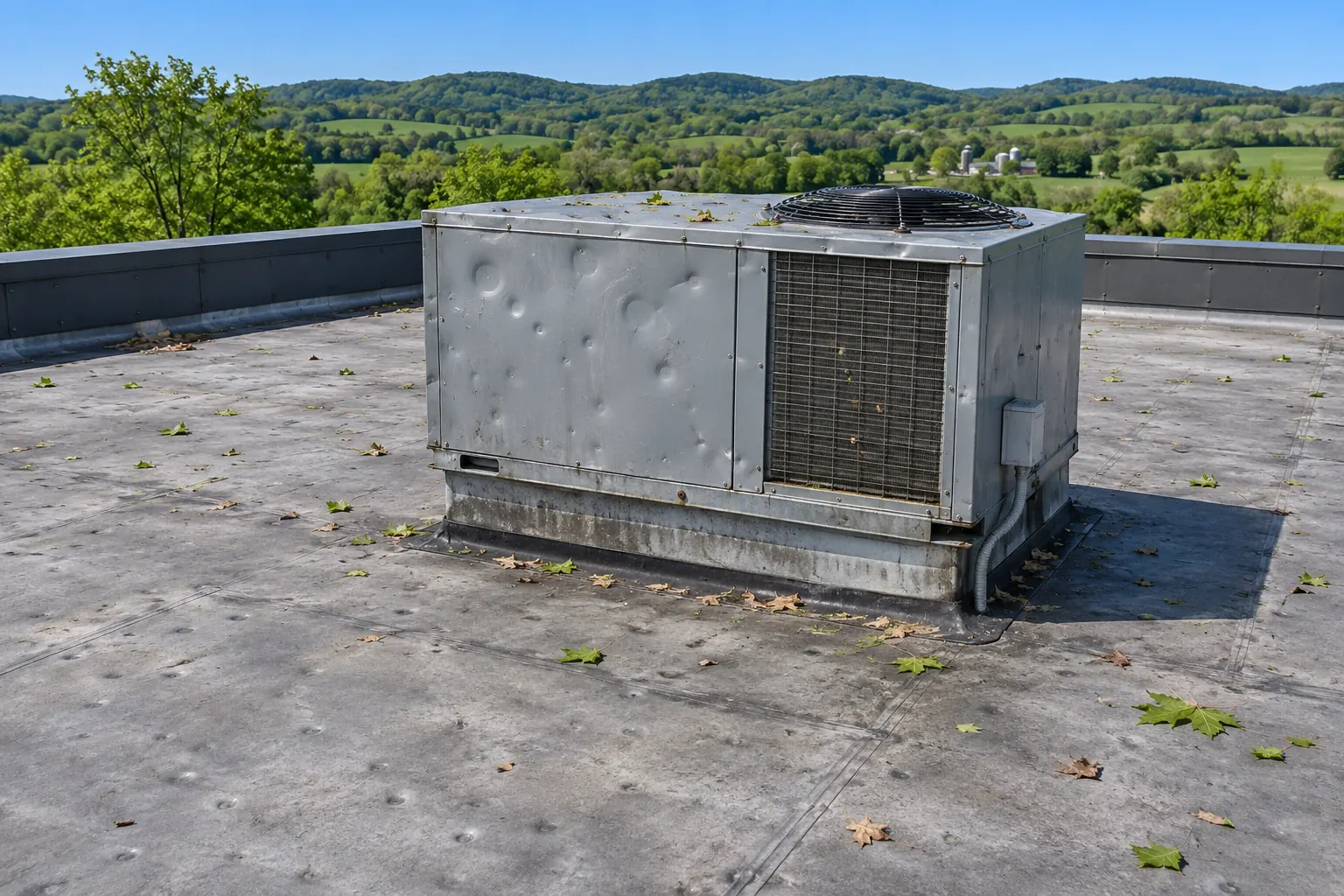
Close view of a worn commercial roof surface at a seam

More Richmond Commercial Roof Repair Questions on Weather and Cost

Below are weather, permits, cost, and town answers. If your roof is leaking now, the first step is a roof walk.

Weather, Permits and Codes in Richmond

Which weather office issues storm warnings for each town in the area?

The NWS office in Louisville covers Madison County, including Richmond and Berea, while the NWS office in Jackson covers Estill, Rockcastle and Powell counties.

TownWarning officeCounty
StantonNWS JacksonPowell
IrvineNWS JacksonEstill
Mount VernonNWS JacksonRockcastle
BereaNWS LouisvilleMadison
RichmondNWS LouisvilleMadison

A hail or wind warning from either office is a good trigger for a roof walk once the storm clears. Start at edge metal, coping and RTU panels on the windward side.

How does freeze and thaw damage a commercial roof?

Freeze and thaw damage a commercial roof when water gets into a crack, seam or lap, freezes, expands and pries the opening wider. Each cycle grows the gap a little more.

Spots that take freeze damage:

  • Open laps on built-up and modified bitumen roofs.
  • Cracked sealant at counterflashing and termination bar.
  • Gutters and downspouts holding ice, which pulls hangers loose.
  • Ponding areas, where ice sits on seams and patches.

Ice dams at the eave of metal roofs push water back under end laps and ridge closures. Late-winter roof checks catch this damage before spring rain finds it.

Which offices handle roof repair permits around Richmond?

Permit needs for roof repairs vary by office and by the size of the work, so check with the office that covers the building before a large repair or any structural change. Small patches are treated differently from reroofing or deck replacement.

TownOffice to askCounty
RichmondCity of Richmond Building Codes DepartmentMadison
BereaBerea Codes and Planning, with state HBC plan reviewMadison
IrvineKentucky HBC, per the Estill County sheetEstill
Mount VernonKentucky HBC, per the Rockcastle County sheetRockcastle
StantonKentucky HBC, plus Stanton Planning and ZoningPowell
McKeeKentucky HBC, per the Jackson County sheetJackson

Deck replacement, new curbs and changes to drains draw the most review.

When is the weather too cold or wet for a permanent roof repair?

Permanent repairs wait for a dry roof surface and temperatures within the limits printed on the primers, adhesives and sealants being used. Wet or frosty membrane keeps primer and seam tape from bonding, and cold slows adhesive cure.

In those conditions, crews make a temporary repair to stop water, then return for the permanent work. Modified bitumen torch work and TPO welding handle cooler days better than adhesive-based repairs, but every repair needs a dry lap.

Metal roof fastener and lap repairs need dry panels for sealant to stick, and dew on the panels delays morning starts.

Cost, Value and Taxes

What affects the cost of a commercial roof repair?

The size of the damaged area, the roof system, access and whether wet insulation has to come out affect the cost of a commercial roof repair most.

FactorEffect on repair cost
Wet insulation under the leakBoards must be cut out and replaced
Membrane age and conditionWeathered TPO or brittle EPDM takes more prep
Number of leak pointsEach one needs tracing and its own repair
Fastener count on metal roofsLabor rises with every screw replaced
Roof height and accessLifts or ladders, and travel time across the roof
Material matchingOlder or unusual systems need special parts

A clean, dry roof with one obvious failed curb costs far less to fix than a roof with leaks across several bays.

When does repeated repair cost more than replacing the roof?

Repeated repair costs more than replacement when the roof needs new patches every season, leaks keep moving to new spots and moisture surveys show wet insulation spreading. Each repair visit adds tracing time, materials and interior cleanup.

Owners comparing the two look at:

  • Number of leak calls the roof has had over the past few years.
  • Share of the roof area that tests wet.
  • Whether seams and flashing are failing in many places at once.
  • Interior damage to ceilings, inventory and equipment.

Restoration with a coating sits between the two when the insulation is still dry.

How are roof repairs treated for taxes, and can Section 179 apply?

Ordinary roof repairs and roof improvements are treated differently for taxes, so a CPA should classify each job. IRS Publication 946 lists roofs among qualified real property improvements to nonresidential buildings eligible for Section 179, with a 2026 limit of $2,560,000 that phases down after $4,090,000 of qualifying property.

Large repairs that replace whole roof sections, new membrane over large areas or replacement panels lean toward improvements. Small fixes like resealing a pitch pan or replacing a few screws lean toward ordinary repairs. Keep invoices that describe each repair by roof area and material.

Questions by Town

Where does a Richmond building owner check whether roof repairs need a permit?

For buildings inside Richmond, the city's Building Codes Department is the office to ask, since its director checks construction plans for code compliance and runs inspections. Bring photos and a short description of the repair, such as replacing a section of deck, rebuilding a curb or resetting a drain.

Buildings beyond the city line answer to Madison County, whose ordinance puts enforcement with the Madison County Building Inspector and excludes working farm buildings. Shops and commercial buildings in the county should confirm with the county office before structural roof repairs.

Which roof checks should Richmond owners make after a storm warning?

Louisville's NWS office issues the hail and wind warnings for Madison County, so those alerts are the signal for a Richmond roof check once the weather clears.

Check in this order:

  • Edge metal, coping and gutters on the windward side.
  • RTU access panels and exhaust fan hoods that wind can open or lift.
  • Membrane around equipment for punctures from flying debris.
  • Drains and scuppers clogged with leaves and limbs.
  • Metal panels and ridge caps for dents, lifted trim and loose screws.

Photograph damage before cleanup for insurance records.

What should Berea owners know about electrical work during roof repairs?

Berea Municipal Utilities provides electric service in its territory, and its new construction page directs electrical permits to either the Madison County Codes Office or the City of Berea Codes Department. That matters when a roof repair reaches a service mast, weatherhead or conduit running across the roof.

Conduit on blocks or straps often sits right over damaged membrane or rusted panels. An electrician lifts or supports it so the crew can repair underneath, then resets it on new supports. Mast flashing gets replaced at the same time. Commercial roof permits in Berea run through the Codes and Planning online portal.

Who answers roof repair permit questions in Irvine?

The Kentucky HBC answers commercial construction permit questions in Irvine, because the state's Estill County sheet lists the county with no local building inspector. Call before repairs that replace deck, raise curbs or move drains.

Irvine falls under the NWS office in Jackson for warnings. After a Jackson hail or wind warning, check edge metal, gutters and RTU panels first. Estill County is served by Blue Grass Energy, Clark Energy and Jackson Energy, so call the right co-op if a repair reaches a service drop at the eave.

How do Mount Vernon owners handle storm damage to a commercial roof?

Mount Vernon owners should watch warnings from the NWS office in Jackson, which covers Rockcastle County, and walk the roof once a hail or wind event passes. Wind lifts edge metal and ridge caps, and hail bruises membrane over soft insulation.

Repairs that only patch membrane or replace screws are routine. Work that replaces deck, adds curbs or changes framing goes to the Kentucky HBC, as the state's Rockcastle County sheet shows. Rockcastle County's co-ops are Inter-County Energy, Jackson Energy and South Kentucky RECC, so check which one feeds the building before work near a service drop.

Do Stanton roof repairs go through the city or the state?

Building permits for commercial work in Stanton go to the Kentucky HBC, while Stanton's Planning and Zoning office covers floodplain and development review plus business licenses. Most leak repairs, seam patches and fastener work stay within the existing roof and footprint.

Larger repairs that rebuild deck, raise parapets or move equipment should be described to both offices. On floodplain parcels, ask Planning and Zoning before structural roof work starts. Gutters and downspouts in Stanton should discharge away from walls after repairs, especially on buildings near low ground. Powell County falls in the Jackson NWS office's warning area.

What should McKee owners know about interior drain leaks?

Interior roof drains in McKee buildings connect to plumbing, and the state's Jackson County sheet points plumbing to the Jackson County Health Department in McKee. A leak that shows up near a column or drain leader can come from the drain pipe under the deck rather than the membrane on the roof.

Crews check the drain bowl, clamping ring and strainer on the roof first. If the roof side holds, the leader joint under the deck is next, and repairs there involve a plumber. Commercial construction permits in Jackson County go to the Kentucky HBC.

Which smaller communities around Richmond get roof repair service?

Roof repair work also reaches six smaller communities spread across five counties.

TownCountyLocal note
WacoMadisonUnincorporated; working farm buildings fall outside the county building ordinance
Paint LickGarrardCounty inspector wants truss drawings for framing work
RavennaEstillKentucky River town at Lock and Dam 12
KingstonMadisonUnincorporated; electrical permits through the county office
Crab OrchardLincolnConfirm the permit office with Lincoln County
LivingstonRockcastleKentucky HBC handles county permits

Shops and commercial buildings in these towns get the same leak tracing and repair work as buildings in Richmond.

Getting Started

What information helps a roofer find a leak faster?

Leak location, timing and roof history help a roofer find a leak faster. The more precisely a drip is tied to a spot in the building, the shorter the search on the roof.

Helpful items to have ready:

  • A floor plan or sketch marking each drip.
  • Notes on which storms caused leaks and from which direction.
  • Records of past repairs and where they were made.
  • Recent equipment work on the roof.
  • Roof hatch, ladder and lift access details.

Photos from inside, including stains on the deck underside, round out the picture.

What does a crew do on site to fix a commercial roof leak?

A repair visit starts with a walk of the roof and a look at the interior leak areas, then moves to tracing the leak and repairing the failed spot. Crews check seams, flashing, curbs, drains, scuppers and edge metal near each leak.

Once the source is found, the crew cuts out wet insulation if needed, makes the repair and checks nearby details for the same problem. Photos before and after the repair go to the owner, along with notes on other spots that need attention soon.

Get Help With Commercial Roof Repair Questions in Richmond

If your roof has a question this list does not answer, send us the details or call, and a roofer will walk it with you.

Get A Free EstimateCall Us