

Roofer walking a commercial roof to check seams and drains
Roof Leak Repair · Richmond, KY

Richmond Commercial Roof Leak Repair Contractor

Find Out Where the Water Is Really Getting Into Your Building

As a Richmond commercial roof leak repair contractor, we trace each drip uphill from the ceiling stain to the seam, curb, or drain letting water in.

  • Membrane Roofs
  • Metal Panel Roofs
  • Built-Up And Mod Bit
  • Plant And Shop Roofs
  • Start PointThe stain inside the building
  • MethodUphill tracing and water tests
  • MoistureMeters and test cores
  • You ReceivePhotos and repair notes

Is This Leak a Spot Repair?

A Richmond commercial roof leak repair contractor first sorts a single entry point from a roof that leaks everywhere. These signs point one way or the other.

Repair Fits When

  • Drips show up in one or two places after rain
  • Leaks follow wind from one direction
  • The water path runs to a curb, boot, or lap uphill
  • A test core shows dry board beside the wet spot
  • Leaks started after equipment work on the roof

Plan For More When

  • Stains appear in new rooms after every storm
  • Moisture surveys show wet board across bays
  • Patches from past visits leak again at the edges
  • Ceiling damage spreads through the building
  • Seams and flashing fail in many places at once

Commercial Roof Leak Repair Clues Inside Richmond Buildings

The inside of the building tells the roofer where to start. The featured clue is the one owners see first.

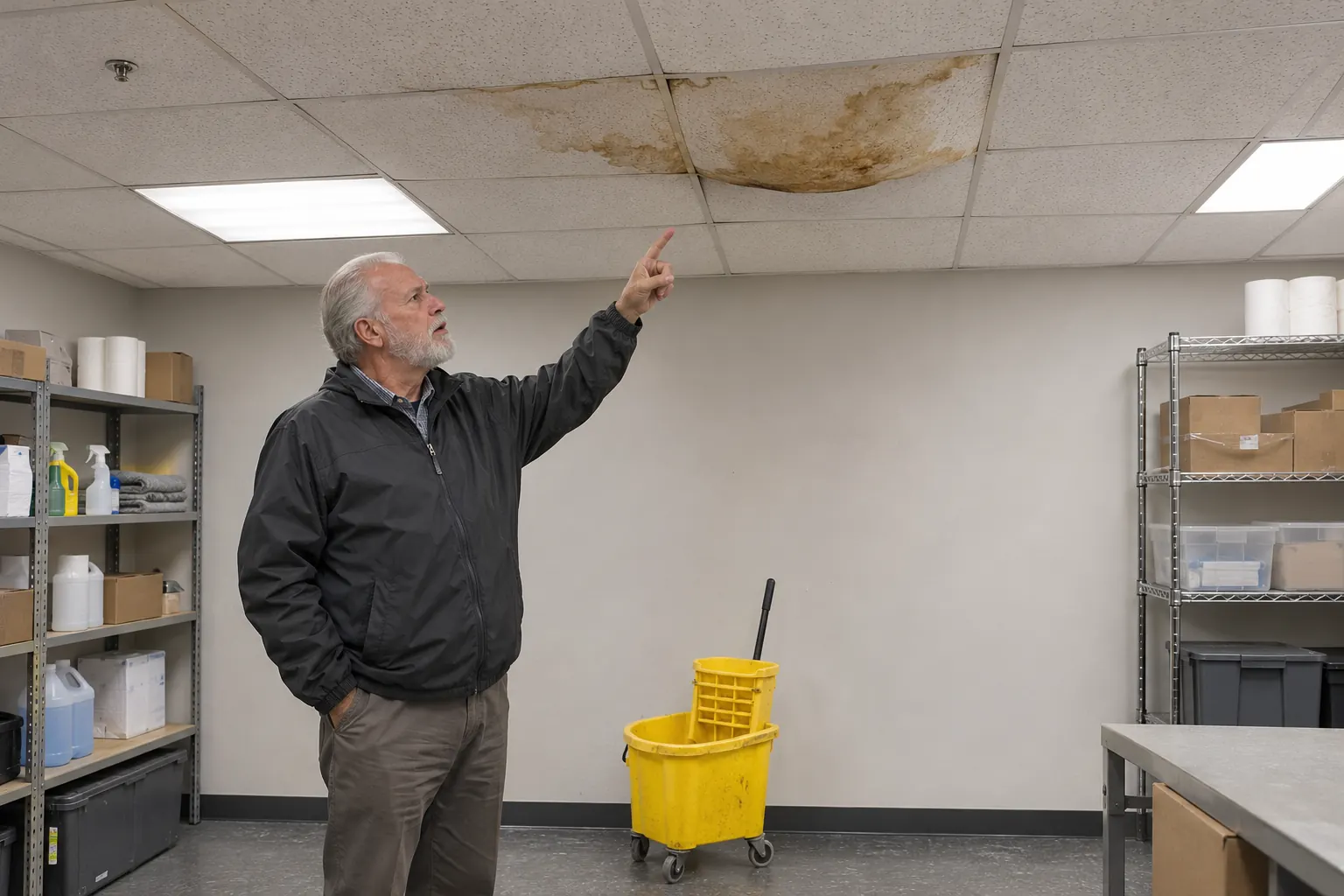
Ceiling stain and drip from a commercial roof leak

A Stain Far From Any Seam

On a steel deck, water can run along the flutes for some distance before it drips through a joint. The stain marks where it came out, and the entry is often uphill toward a curb, a pipe, or an open lap.

Usually MeansThe trace starts at the stain and works uphill on the roof.
  • Leaks Only In Wind

    Rain blown from one side points to edge metal, coping, or counterflashing on that wall.

  • Drips At A Column

    Water near a column or drain leader can come from the drain pipe under the deck.

  • Soft Spots Underfoot

    A spongy feel on the roof means wet board that has to come out before patching.

  • Repeat Leaks

    A patch that keeps failing often sits over wet board or the wrong material.

Commercial Roof Repair Options for Richmond

Leak work comes down to four tools. Which ones a visit uses depends on how clear the water path is.

How To Trace A Commercial Roof Leak

Each ceiling stain is marked on a plan, matched to a spot on the roof, and every seam, curb, and pipe uphill of it is checked for open laps, split flashing, and loose fasteners.

Water Testing

When visual checks come up empty, suspect spots are flooded with water one at a time, starting downhill. A drip inside while one spot runs pins down the entry.

Finding Wet Roof Insulation With Infrared

Infrared scans at night after a sunny day show wet board releasing heat slowly. Capacitance meters map the same areas, and small test cores confirm the readings and are patched right away.

Permanent Repair At The Source

Once the entry is found, wet board is cut out, the failed seam, curb, or drain is repaired in matching material, and nearby details are checked for the same problem.

Benefits of Repairing Your Roof

Finding the real entry point once costs less than chasing the same stain every few storms.

Owner

  • One traced leak replaces several guesses and patch visits.
  • Wet board found early limits how much insulation comes out.
  • A written record shows which seam or curb failed and when.

Facility Manager

  • Fewer ceiling tile swaps and fewer bucket calls from tenants.
  • Repair notes flag the next curb or drain likely to fail.
  • A clear water-path map helps the next roofer on the job.

Tenants And Staff

  • Dry aisles and desks under the old drip point.
  • Less risk of slips on wet floors near the entrance.
  • Rooms back in use once the stain source is closed.
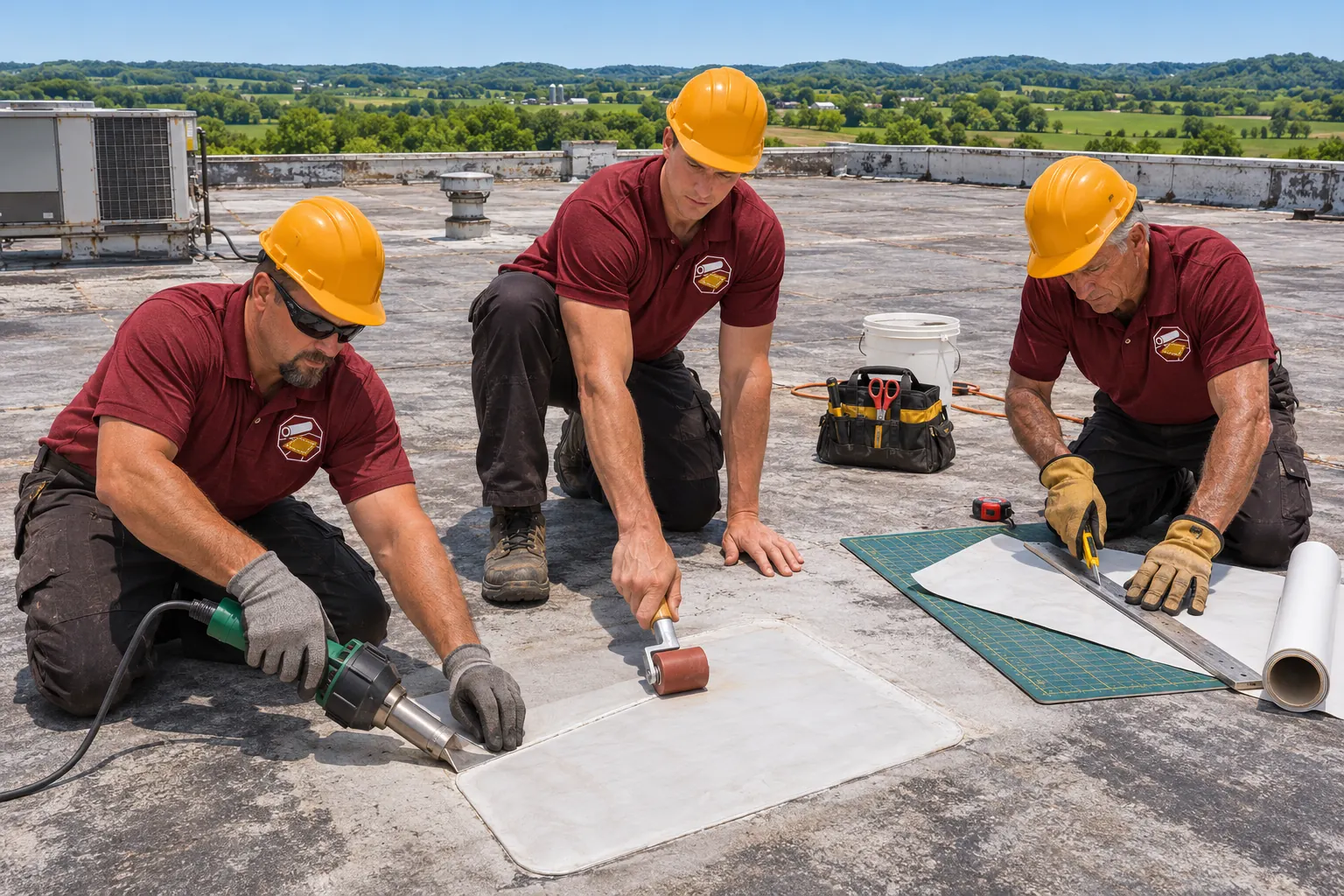
Roof repair crew working on a section of a commercial roof

Leak Came Back After the Last Patch?

Repeat leaks usually mean the first repair treated the wrong spot. A full trace from the stain uphill finds the entry that was missed.

How a Richmond Commercial Roof Leak Repair Contractor Traces Water

Leak tracing follows a fixed order, so nothing on the water path gets skipped.

Stage 1

Inspect Your Roof

The roofer starts inside at each stain, measures its position from walls or column lines, and checks the deck underside for runs of water along beams.

Stage 2

Map The Path Uphill

On the roof, the matching spot is found and every seam, curb, and penetration uphill of it is checked. Wind direction from your notes narrows which wall to start on.

Stage 3

Test Suspect Spots

Spots are water-tested one at a time from the downhill end, and moisture readings mark wet board around the entry so the patch goes over dry material.

Stage 4

Fix And Recheck

Repairs go in at the source, then the same area is checked after the next rain. Photos and a marked plan go to you with the notes.

Repairs That Follow a Leak Trace

Once the entry point is found, the repair belongs to one of these jobs.

Seams And Flashing

Openings at laps, curbs, or boots on a membrane roof are closed with flat roof repair in matching sheet.

Screws And Laps

Water getting in along screw rows or panel laps on steel buildings needs metal roof repair and a full fastener pass.

Fans And Vents

Sources around exhaust fans and process vents call for industrial roof repair with residue-resistant patches.

Best Commercial Roof Leak Repair Answers for Richmond Owners

Answers on tracing leaks and stopping them.

  1. 01

    How do roofers trace a leak on a commercial roof?

    Start at the interior stain, measure where it sits, and work uphill on the roof from that point. Mark the stain on a plan, check every seam, curb, and pipe uphill, look for open laps and split flashing, then water-test suspect spots one at a time from the downhill end.

  2. 02

    Where do leaks start on each type of commercial roof?

    TPO and PVC leak at cold welds, T-joints, and boots. EPDM leaks at seam tape edges and termination bar. Mod bit and built-up leak at blisters, laps, and pitch pans. Metal roofs leak at seam ends, closures, screws, and gutters. Skylights, RTU curbs, and parapets show up on every list.

  3. 03

    Can wet insulation be found before cutting into the roof?

    Yes. A moisture survey with infrared, capacitance, or similar meters maps the areas holding water, and small test cores confirm what the meter shows. That matters because a patch over soaked board leaves water trapped under the membrane, so those boards come out first.

  4. 04

    What should building staff do when water comes through the ceiling?

    Protect people and contents first: move equipment, set out buckets, and rope off wet floors. Stay off the roof in storms. Then record each drip by column line or room number, the time it started, the wind direction, and photos of tiles and deck stains.

  5. 05

    Why does the same commercial roof keep leaking after repairs?

    Usually the first repair treated the wrong spot or used material that cannot bond, like roof cement on a TPO seam. Wet board left under a patch, clogged drains, movement at joints, and a second leak nobody found also cause repeats. A full roof check breaks the cycle.

Call a Richmond Commercial Roof Leak Repair Contractor

Send the address and where the water shows up inside, and we will trace it back to the spot on the roof.

Get A Free EstimateCall Us